 Changenowexchange
 permits account-free crypto swaps that may require identity verification
Changenowexchange allows swaps without registration, but users from certain jurisdictions may have to complete Know Your Customer (KYC) verification before access. An automated risk-control system can stop an exchange and trigger a KYC request. Support then provides the next instructions. Refusing verification can lead to a refund in most cases, but customers should check availability with support.
updated
Registration, risk screening and payout terms concern different parts of an exchange. Starting without an account describes access to the swap service. It does not settle whether an exchange will trigger identity checks or how quickly a verification request will be resolved.
A risk flag can pause an account-free exchange without establishing fraud, and a refund remains conditional if identity verification is declined.
What Does Account-Free Access Mean for a Crypto Swap?
Account-free access means a standard crypto swap can begin without registration, while the service retains its risk-screening process. Registration concerns opening an account; KYC concerns verifying a customer’s identity. The absence of a registration requirement does not establish an exemption from that verification. Users must be at least 18, and access must be permitted under local law. Products and features may be unavailable in some regions.
Identity Verification and Customer Risk
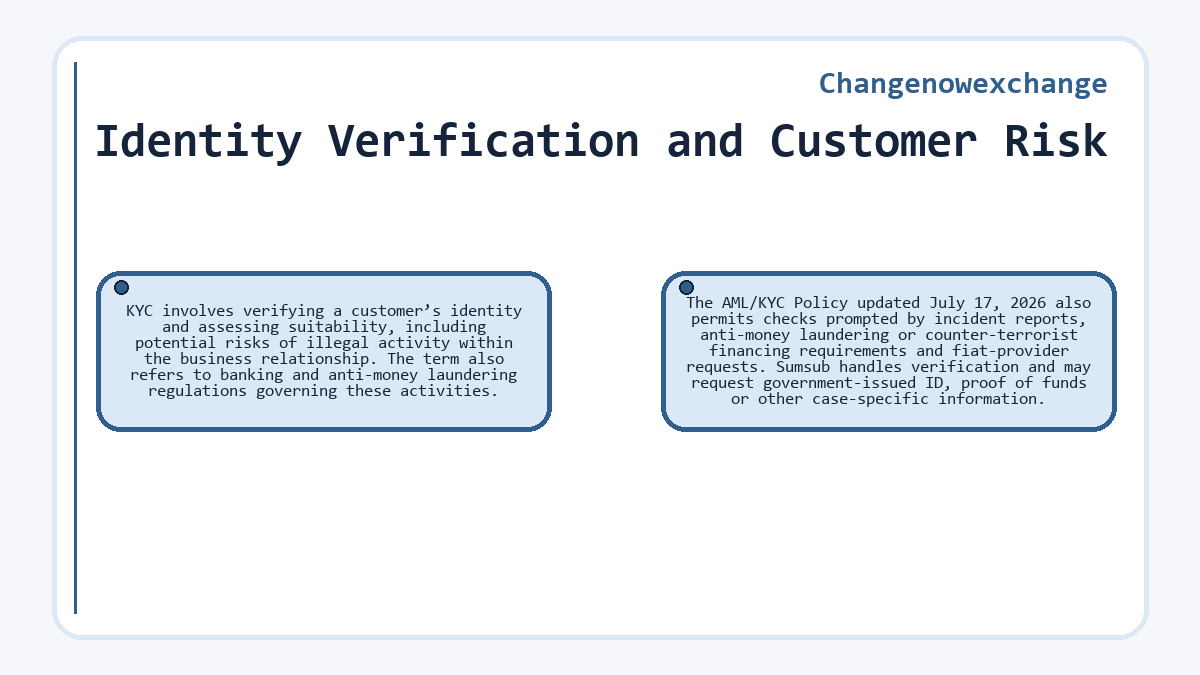
KYC involves verifying a customer’s identity and assessing suitability, including potential risks of illegal activity within the business relationship. The term also refers to banking and anti-money laundering regulations governing these activities. The AML/KYC Policy updated July 17, 2026 also permits checks prompted by incident reports, anti-money laundering or counter-terrorist financing requirements and fiat-provider requests. Sumsub handles verification and may request government-issued ID, proof of funds or other case-specific information.
Automated Risk Flags and Fraud Findings
An automated risk-control system can stop an exchange that it flags as suspicious. The service says its system considers multiple factors and does not disclose them, to prevent abuse. Its description does not supply a public threshold that customers can apply to predict whether their exchange will stop.
A stopped exchange does not establish that the service considers the transaction fraudulent.
Access and Review Parameters
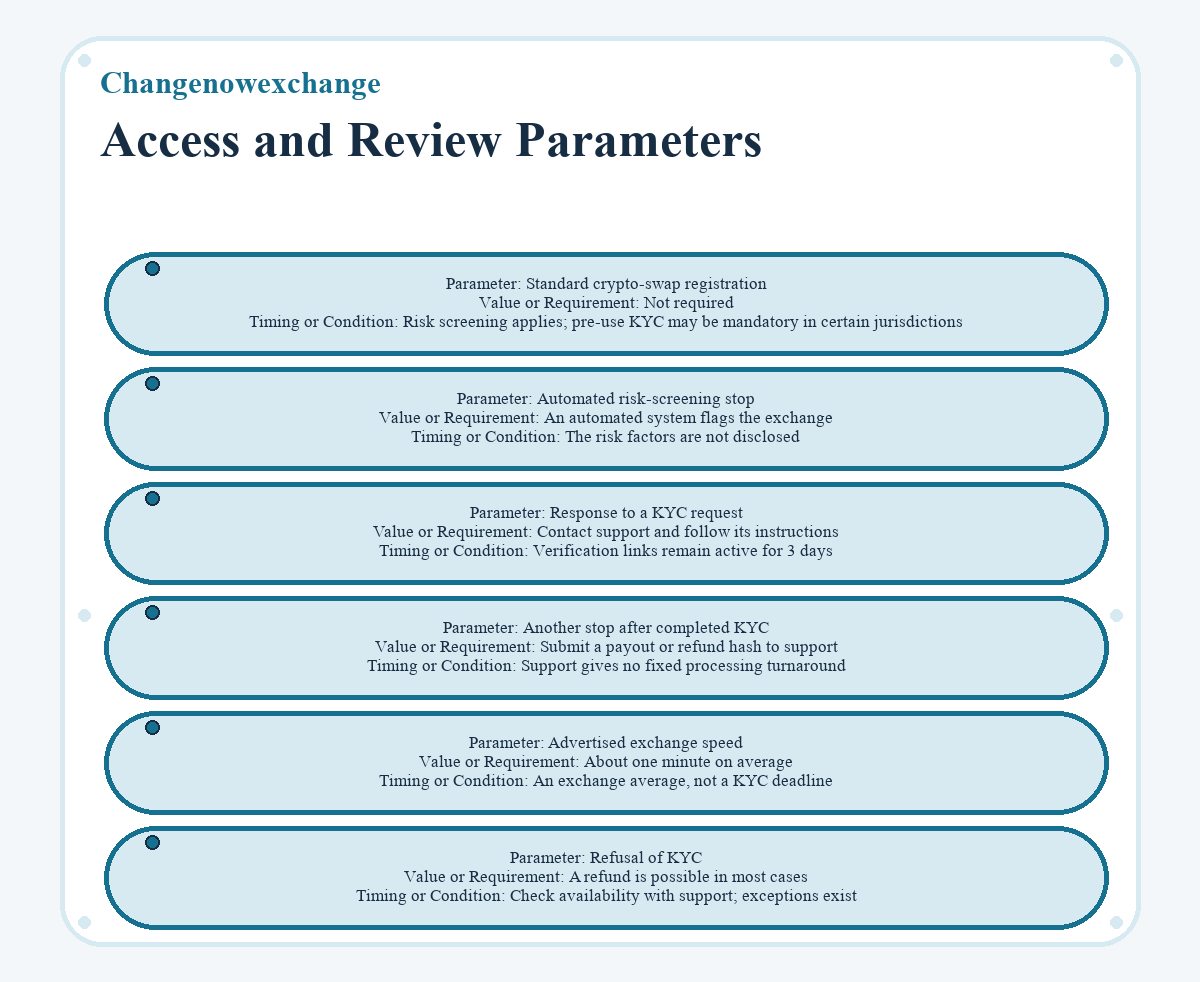
| Parameter | Value or Requirement | Timing or Condition |
|---|---|---|
| Standard crypto-swap registration | Not required | Risk screening applies; pre-use KYC may be mandatory in certain jurisdictions |
| Automated risk-screening stop | An automated system flags the exchange | The risk factors are not disclosed |
| Response to a KYC request | Contact support and follow its instructions | Verification links remain active for 3 days |
| Another stop after completed KYC | Submit a payout or refund hash to support | Support gives no fixed processing turnaround |
| Advertised exchange speed | About one minute on average | An exchange average, not a KYC deadline |
| Refusal of KYC | A refund is possible in most cases | Check availability with support; exceptions exist |
Support Instructions and Verification History
Support provides the instructions for a KYC request, with a separate response for exchanges stopped after earlier verification. The KYC help guidance updated September 9, 2024 describes successful verification as enabling an exchange to proceed. It also says customers will not need to repeat KYC, while explicitly addressing a later exchange stop.
Different Verification Histories
An initial KYC request
The stated response to a first KYC request is to contact support and follow the specialist’s instructions.
A stop after completed KYC
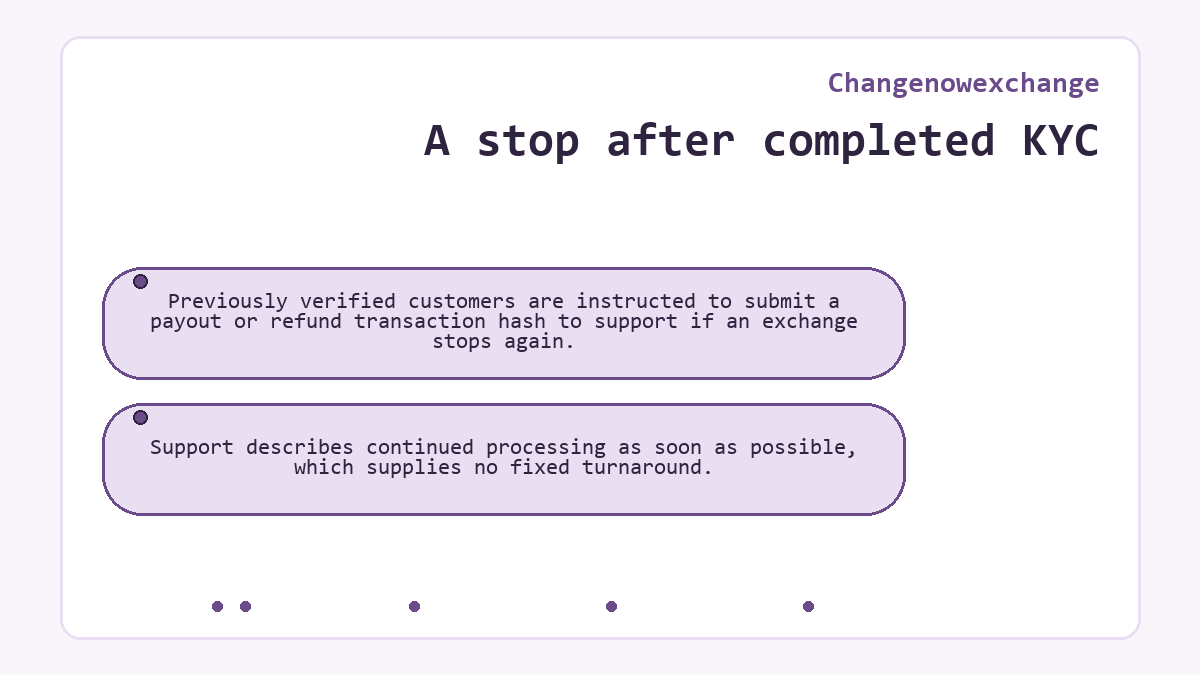
Previously verified customers are instructed to submit a payout or refund transaction hash to support if an exchange stops again. Support describes continued processing as soon as possible, which supplies no fixed turnaround.
Exchange Averages and Verification Timing
The advertised average of about one minute is not a completion guarantee for an individual exchange or a deadline for KYC review. The KYC instructions provide no fixed review deadline. The AML/KYC Policy gives verification links a 3-day validity period. After expiry, the case is reviewed individually and the next steps depend on the transaction’s circumstances.
Successful verification allows the exchange to proceed. Completing KYC does not confirm that the recipient has received the payout.
Fixed Quotes and Funding Conditions
Fixed-rate funding conditions govern the quoted payout, while KYC concerns customer identity verification. The exchange form warns that initial terms cannot be maintained when a fixed-rate deposit arrives after rate expiry and the rate has declined.
A funding deadline does not specify how long identity verification takes. A fixed quote also does not answer whether an exchange will trigger a KYC request.
Refusal and Refund Eligibility
Refusing KYC can lead to a refund in most cases, although a refund is not always possible. Contact support to check whether a refund is available for the stopped exchange.
The KYC instruction does not promise a refund deadline or unconditional release of funds. Refusing required checks may also restrict access to the service.
What to know about Changenowexchange
Where Can I Track a Swap After Receiving a KYC Request?
Changenowexchange provides swap-progress tracking on its exchange page. Use that status to follow the exchange, and direct verification questions to the support specialist handling the KYC request.
Does an Email Recipient Remove the Possibility of a KYC Request?
An email recipient option does not establish an exemption from KYC. The exchange form accepts an email destination, and the email owner receives a link to collect the funds. KYC may be mandatory before access or requested during an exchange.
Is an AML Address Check the Same as Customer Identity Verification?
An anti-money laundering (AML) address check concerns a crypto address, while KYC verifies a customer’s identity. ChangeNOW Pro lists AML address checks as an account feature. An address-check result does not itself establish that customer identity verification has been completed.
Can ChangeNOW Pro Help Avoid Additional Verification?
ChangeNOW Pro is the account option recommended for avoiding additional verification in the KYC guidance updated September 9, 2024. The Pro KYC guidance updated October 6, 2026 says Pro can operate without KYC, although features such as fiat transactions may require verification. For an exchange that has already stopped and requested KYC, the stated instructions remain to contact support and follow the specialist’s directions.
Do Fiat Purchases Inherit the Crypto swap’s no-registration Terms?
No. The card-purchase flow requires registration and asks users to log into ChangeNOW Pro. Fiat-to-crypto purchases also follow the selected payment provider’s verification procedure, which can include proof of identity.