 Changenowexchange
 refunds depend on deposit status and case-specific support review
Changenowexchange refunds begin with a support request when funds have already been sent for an exchange. Before any deposit, an unwanted order can remain unfunded while a new exchange is created. After sending funds, contact support immediately for cancellation assistance. Refund eligibility varies with the issue: refusing identity verification permits a refund in most cases, while an expired fixed quote or contract-address error needs support review. A request alone does not establish that funds have been returned.
updated
Key takeaway: The fixed-rate funding deadline controls quote protection, while a refund request needs a separate assessment from support.
Unfunded Exchanges and Funded Cancellation Requests
Deposit status separates an unused exchange order from a cancellation request involving funds that have already been sent. An unfunded order needs no cancellation action. The exchange instructions allow it to remain unused while a new order is created. With no deposit attached to that order, there is no deposited amount to return.
Once funds have been sent, contact support immediately for cancellation assistance. The request concerns the funded exchange, even if another order has since been created. The refund help article updated September 30, 2026 excludes finished orders with on-chain payouts and orders partly or fully through the exchange stage. It also excludes deposits below the asset’s network fee and cases where the service cannot access unsplit BCH/BSV coins or unsupported funds. Section 2.2 of the terms separately allows returning unexchanged assets less fees after significant market changes, while converted assets go to the payout address.
Available Responses and Refund Constraints
Refund-related support requests differ between an unused order, a funded cancellation and an exchange that cannot proceed on its initial terms. Required identity verification adds a separate eligibility condition.
| Exchange Condition | Available Response | Limit on the Outcome |
|---|---|---|
| Unfunded order | Leave it unused and create a new exchange. | No deposited funds require a refund. |
| Funds already sent | Contact support immediately for cancellation assistance. | A cancellation request does not itself confirm refund eligibility. |
| Fixed-rate deposit sent after expiry, with a rate decline | Contact support about continuation or request a refund. | The exchange cannot proceed on its original terms. |
| Wrong contract address | Ask support about continuation or a refund request. | The initial exchange terms cannot be applied. |
| Required identity verification refused | Ask support whether a refund is possible. | Refunds are possible in most cases, although exceptions apply. |
| Fiat purchases also involve the selected payment provider and any bank-related payment issue. | ||
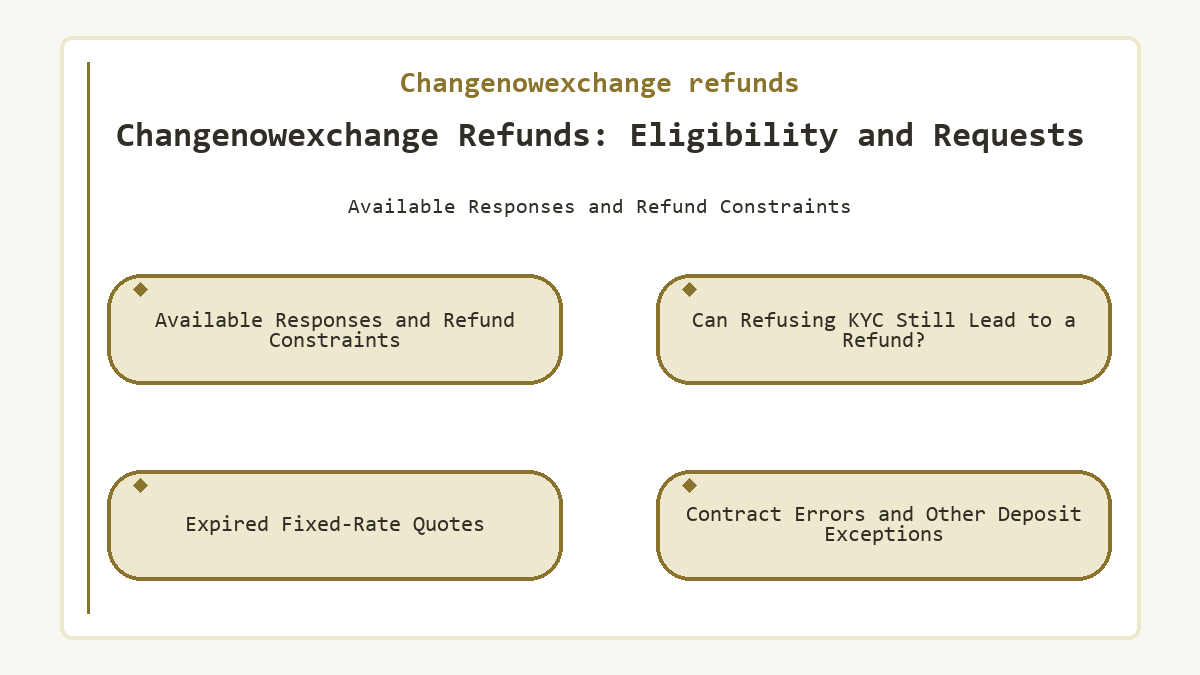
Changenowexchange Refunds: Eligibility and Requests
- Available Responses and Refund Constraints
- Can Refusing KYC Still Lead to a Refund?
- Expired Fixed-Rate Quotes
- Contract Errors and Other Deposit Exceptions
Can Refusing KYC Still Lead to a Refund?
Refusing required Know Your Customer (KYC) identity verification allows a refund in most cases, although exceptions apply. Support must confirm availability for the particular exchange.
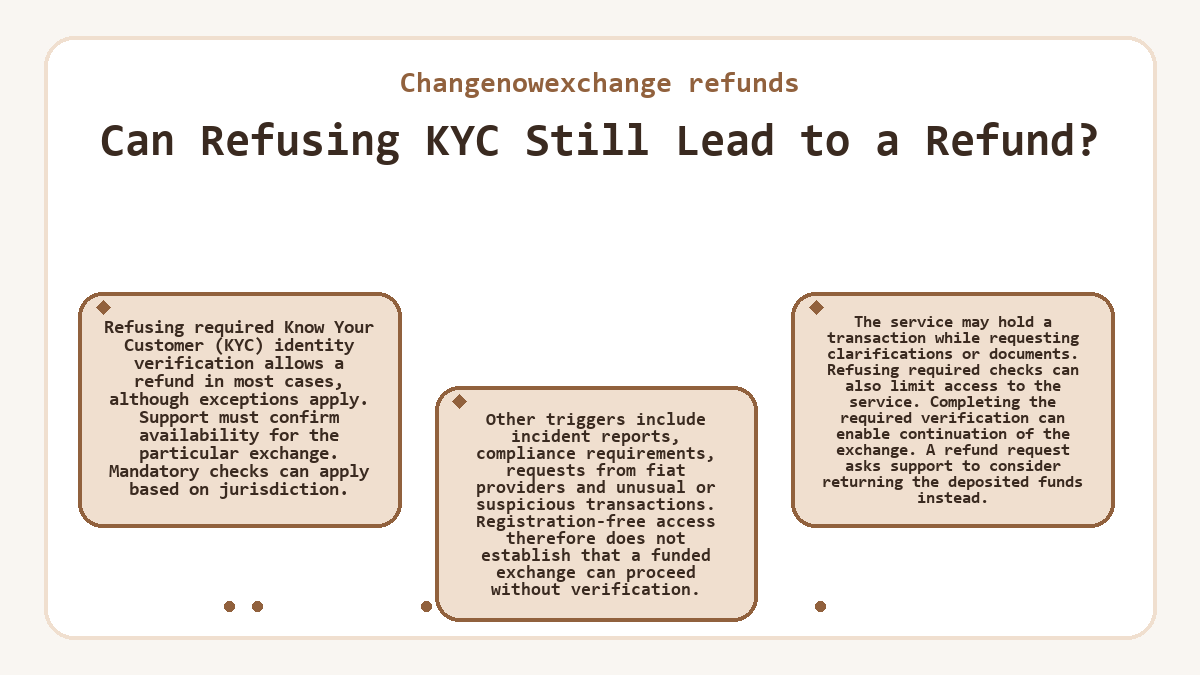
Mandatory checks can apply based on jurisdiction. Other triggers include incident reports, compliance requirements, requests from fiat providers and unusual or suspicious transactions. Registration-free access therefore does not establish that a funded exchange can proceed without verification.
The service may hold a transaction while requesting clarifications or documents. Refusing required checks can also limit access to the service.
Completing the required verification can enable continuation of the exchange. A refund request asks support to consider returning the deposited funds instead.
Expired Fixed-Rate Quotes
A fixed-rate exchange cannot proceed on its initial terms if its deposit is sent after expiry and the rate declined during that interval. Support can then discuss continuation or receive a refund request.
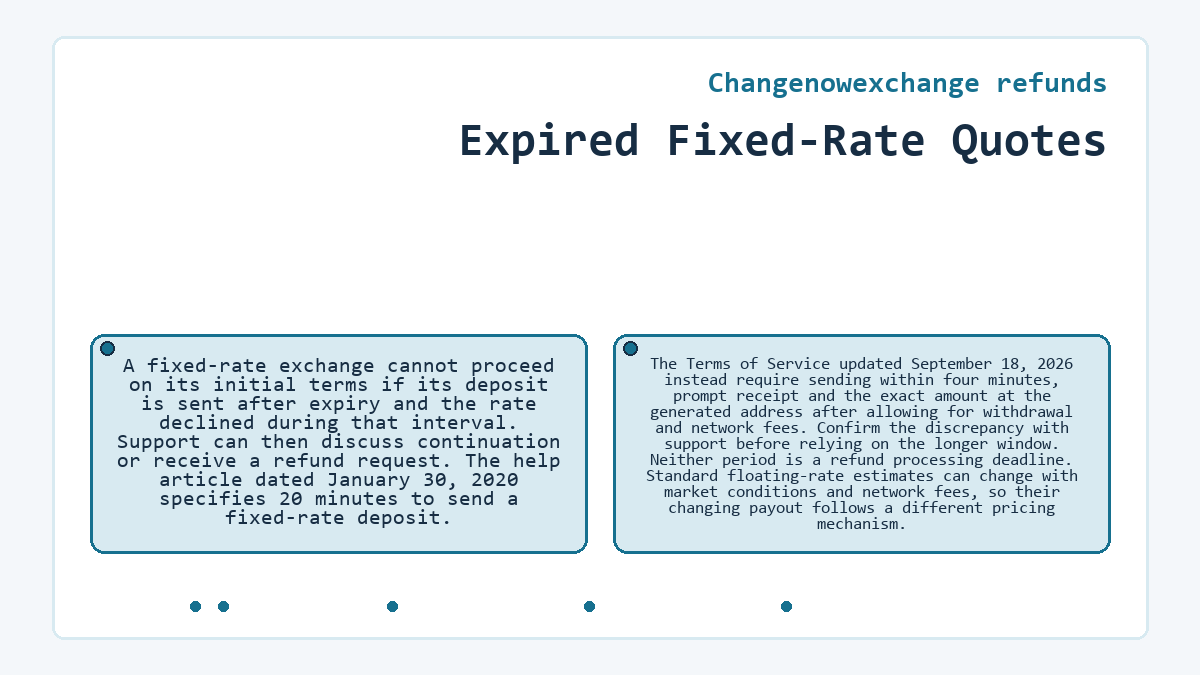
The help article dated January 30, 2020 specifies 20 minutes to send a fixed-rate deposit. The Terms of Service updated September 18, 2026 instead require sending within four minutes, prompt receipt and the exact amount at the generated address after allowing for withdrawal and network fees. Confirm the discrepancy with support before relying on the longer window. Neither period is a refund processing deadline. Standard floating-rate estimates can change with market conditions and network fees, so their changing payout follows a different pricing mechanism.
Contract Errors and Other Deposit Exceptions
A wrong contract address prevents the exchange from proceeding on its original terms and requires support to assess further handling. The exchange instructions provide for discussion of continuation or a refund request in this situation. Asking for a return does not establish that the affected transfer can be recovered.
Other deposit irregularities receive different treatment. The exchange page lists continued processing for multiple deposits, wrong-coin deposits and deposits long after order creation or completion. It also lists wrong-network deposits if the asset is supported. The terms instead restrict each exchange to one deposit, so ask support to clarify handling when several deposits were sent. An unusual deposit is therefore not automatically a refund case.
Fiat Purchases and Bank Holds
A stalled fiat purchase involves the payment provider and bank as well as the exchange order, which changes the refund inquiry. Provider verification and a bank payment problem concern different parts of the purchase.
Fiat troubleshooting covers purchases processed with Simplex, Guardarian, Transak and Banxa.
A bank can decline the fiat transfer. The customer should ask the bank to clarify that outcome. A declined transfer and funds locked by a bank are different payment states, even when both accompany an unfinished order.
If provider verification is complete, the bank has locked the funds and the purchase remains stuck or incomplete, contact support about the unresolved order. That review concerns the fiat payment’s circumstances. A bank hold does not itself establish that a crypto refund has been initiated.
Refund Amounts and Processing Time
Refund amount and timing need confirmation for the specific exchange, because the displayed swap quote describes the exchange payout. Fees included in that rate do not establish the net amount of a later return. Ask support which asset and net amount would return. Section 6.16 of the terms specifies a USD 50 processing fee for refunds following wrong-network, wrong-asset or unsupported-asset deposits, or a missing or incorrect required memo (deposit identifier). This fee is invoiced separately through NOWPayments; network fees also apply. Section 6.6 allows up to 20 business days for asset extraction, not for every refund. The advertised average exchange time of about one minute does not set a refund payment deadline.
Return Transfers and Completion Evidence
Refunds default to the address that sent the deposit. The terms permit that address or the refund address specified at exchange creation, and exclude newly supplied addresses. A completed crypto refund requires receipt at the permitted destination; support approval alone does not confirm receipt. A transaction hash identifies a blockchain transaction, including one that is pending or unsuccessful. The corresponding network record can show transaction status, asset movement and destination.
The receiving wallet’s transaction history provides another check on the returned asset and amount. Those details must match the return that support agreed to send. A mismatch requires clarification from support, even when the exchange page shows progress.
What readers ask about Changenowexchange refunds
What Happens If a Verification Link Expires During My Refund Inquiry?
A verification link remains active for three days, after which the case receives an individual review. The next steps depend on the transaction’s circumstances. That period governs access to the verification link; it does not establish a deadline for returning funds. Ask support how the expired link affects the outstanding refund inquiry.
Which Documents May a Refund-Related KYC Check Require?
A refund-related review that requires KYC may involve a valid government-issued ID, proof of funds or other case-specific information. Sumsub handles identity verification and stores and processes the submitted documents.
Does a Risk-Control Stop Prove That My Refund Involves Fraud?
An automated risk-control stop does not establish that the transaction is fraudulent. The system can flag an exchange for further review and requests for clarification. Refund availability still needs a case-specific response from support, particularly when required verification is refused. The reason for the hold and eligibility for returning funds are separate questions.
How Can I Follow Up on a Refund Inquiry After Passing KYC?
The help instructions ask for the hash of your payout or refund if an exchange stops after you have already passed KYC. Give that information to support when following up on the stopped exchange. The identifier supports the inquiry; it does not establish approval of a new refund request or the timing of another return.
Where Can I Look for Verification Requests Before Asking About a Fiat Refund?
Check the email address entered for the fiat order for messages from the selected payment provider. The fiat troubleshooting instructions call for an accessible email address and completed provider verification. An outstanding identity request can explain why the purchase remains unresolved. The message helps distinguish a verification issue from a bank’s decision to decline the transfer.
Can Case Information Be Shared With Authorities During a Refund Review?
Certain information may be shared with competent authorities only after a valid, lawful and verifiable official request. The requesting body must supply the legal basis, scope of requested data and verifiable contact details.